
“Where am I in all of this? Where do I fit into this? Why isn’t my culture talked about? Why is there no reflection of who I am here? Is there no value in it? Is there no value in me? Do I belong here?… I couldn’t see a relevance in learning in a system that couldn’t see a relevance in me.” Lisa Smith, Travellers Times
FIND OUT MORE
Definitions
The materials in this toolkit differentiate between those people who identify to the term ‘Scottish Gypsy/Traveller,’ from the phrase ‘Gypsy/Traveller in Scotland’, which can have a broader application alluding to Scottish and Irish Travellers, as well as Roma from Central/Eastern Europe and English Romani who live or lived in Scotland. Scottish Gypsy/Travellers as an ethnic group are protected by the Equality Act 2010.[15] The group is connected to a historic nomadic, cultural way of life that has existed for hundreds of years. The records of Gypsy/Travellers in Scotland dating back to at least the 12th century. Scottish Gypsy/Travellers may identify as ‘Traveller’ but some may also self-define as ‘Nacken’ or ‘Nawken’or as ‘Indigenous Highland Travellers’.[22]
The cultural iceberg
The iceberg analogy offered by Edward T Hall (1976) helps our understanding of the Gypsy/Traveller culture. Hall suggests that there are some parts of cultures that are visible above the water but there is a much larger part that is hidden beneath the surface. The model teaches us is that we cannot judge people from cultures different to our own based only on what we see. It is important to get to know individual people from that culture and learn with and from them (see video clips). Only by doing so can we gain some understanding of the values and beliefs that underlie the behaviour of community members.
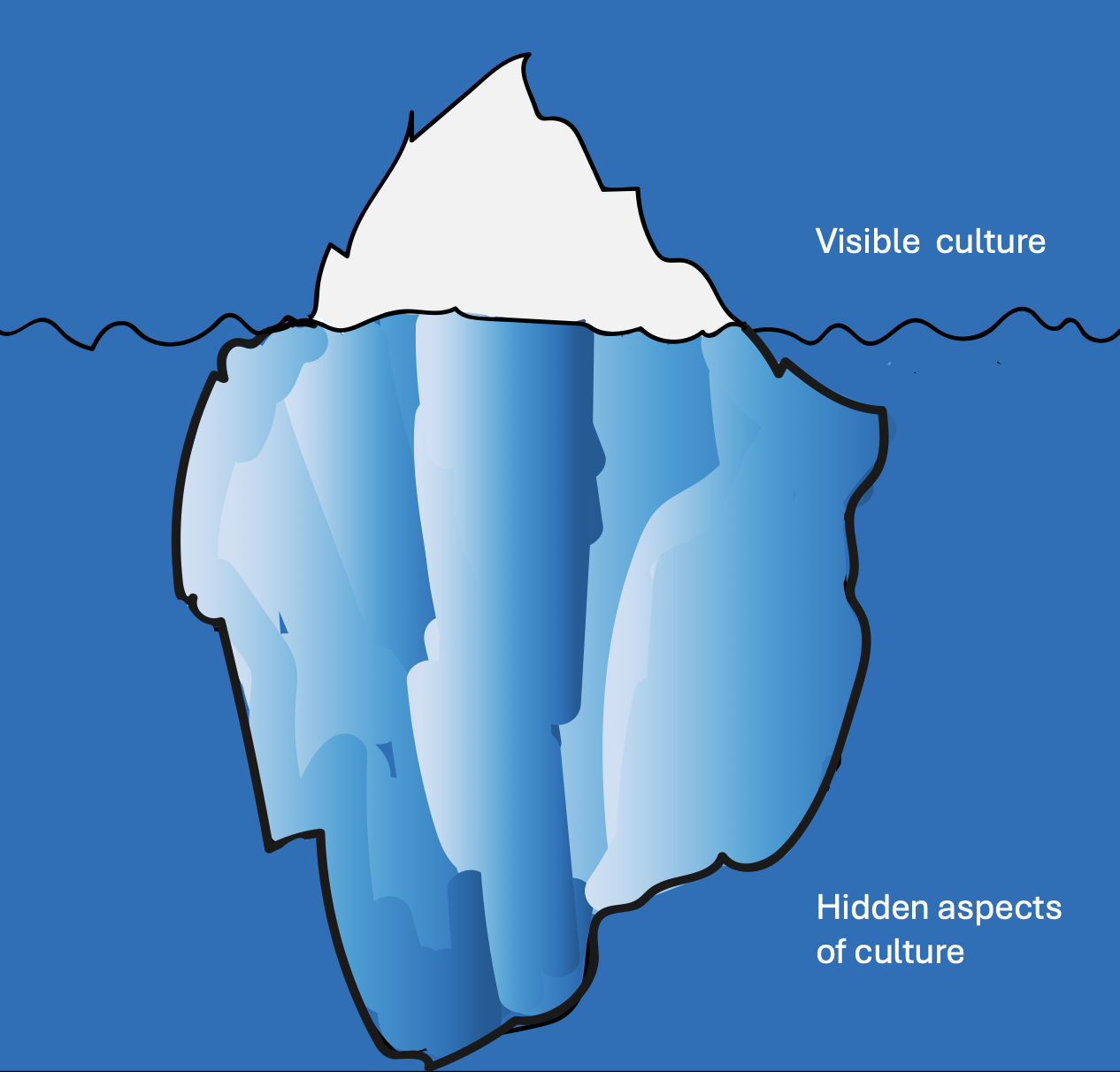
The visible aspects of a culture can include: food, language, dress, symbols and icons, music, holidays and festivals. It is also useful to be aware of stereotypes and how attitudes in wider society can have an influence on how cultures are viewed. Moreover, the Gypsy/Traveller cultures are not homogenous. They are complex and dynamic and can be experienced and viewed differently from person to person.
The less visible aspects of the Gypsy/Traveller culture that can have an influence on how individuals behave include: family roles and values, ideas of beauty, notions of modesty, patterns of handling emotions, money, decision-making models, concepts of time, collective identity, relationship to environment, gender roles, concepts of cleanliness, humour, pride, approaches to health and medicine, childrearing practices, attitudes towards school, personal space.
At a deeper level people from the Gypsy/Traveller cultures can hold a world view that is influenced by a tradition of nomadism, a history of persecution, and inherited values and concepts of justice. The best way to find out more about a culture is through communication with its members.